
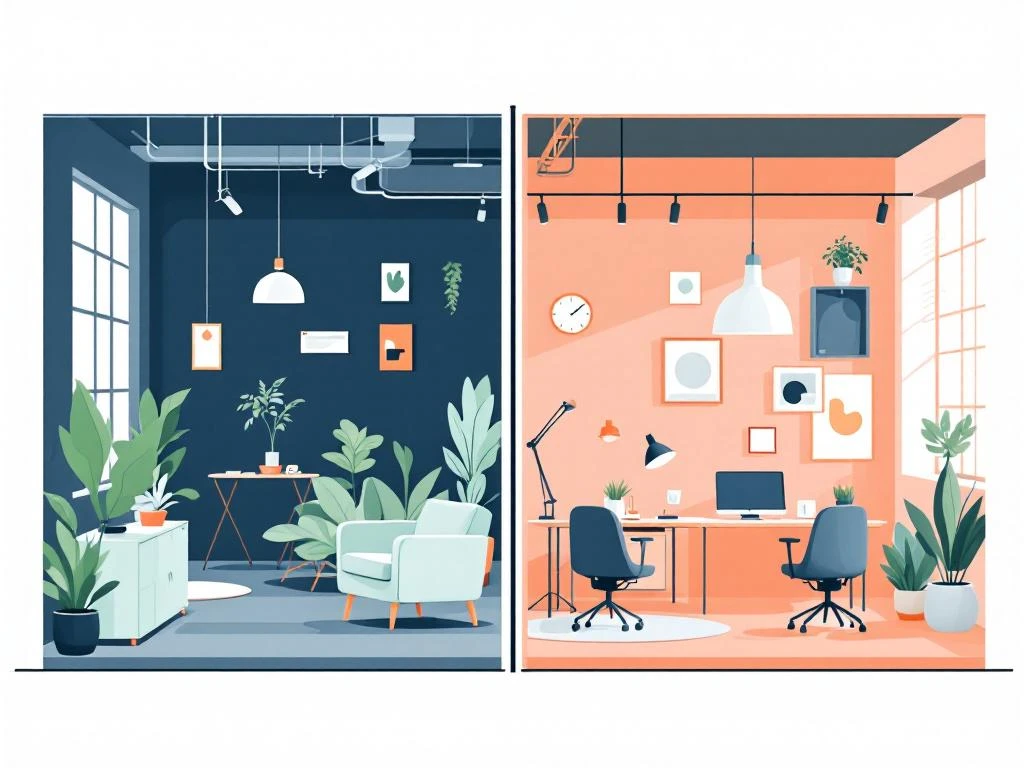

Coworking spaces and traditional offices differ fundamentally in their design and functionality. Coworking spaces offer flexible workplaces in a shared environment where different professionals and businesses work together, whereas traditional offices are fixed, exclusive spaces for one organization. The main difference is in the flexibility of contracts, community-oriented approach and all-in services offered by coworking spaces versus the stability and privacy of traditional offices. These differences affect not only the work experience but also the cost structure and productivity.
What are the main differences between coworking spaces and traditional offices?
The main differences between coworking spaces and traditional offices lie in the structure, design and underlying philosophy. Traditional offices are designed for one company with fixed layout and hierarchy, while coworking spaces revolve around shared facilities and flexibility.
With traditional offices, you rent an entire space that you can set up as you wish, where you have complete control over who has access. You decide the office layout, corporate culture and house rules. This offers stability but often requires long-term commitments.
Coworking spaces, on the other hand, offer workspaces in a shared environment. You can choose from flex spaces, fixed desks or private offices within a larger community. Infrastructure, facilities and support services are shared with other members.
The philosophy behind coworking revolves around community building, knowledge sharing and networking. These spaces are designed to encourage casual encounters and foster collaboration among members, something that is less obvious in traditional offices.
How does the cost structure at coworking spaces differ from traditional office rentals?
The cost structure of coworking spaces differs significantly from traditional office leasing due to the focus on flexibility and transparency. With coworking spaces, you usually pay an all-in monthly fee with no long-term commitments, while traditional offices often require multi-year leases with additional fees.
For traditional offices, consider:
- Long-term leases (often 3-5 years)
- Deposit and bank guarantees
- Separate charges for internet, cleaning and utilities
- Investment in furniture and fixtures
- Maintenance costs and insurance
At coworking spaces, the cost approach is simpler:
- Monthly or flexible subscriptions
- Includes wifi, cleaning, coffee and facilities
- No major pre-investment in furnishings
- No obligations for maintenance or repairs
- Ability to scale up or down as needed
These differences make coworking spaces more financially accessible to start-up companies and offer more flexibility as they grow or shrink. Traditional offices only become cost-effective with stable growth over long periods of time.
What benefits do coworking spaces offer that traditional offices do not?
Coworking spaces offer several unique advantages that traditional offices cannot match, the most important being the community-oriented environment and flexibility. These benefits explain the growing popularity of coworking as a modern workplace model.
The biggest advantage is the built-in networking opportunity. You work daily among professionals from different sectors, which leads to new contacts, collaborations and insights. Many coworking spaces also organize events, workshops and get-togethers specifically to strengthen this community.
Flexibility in subscriptions is another major plus. You can customize your workspace to suit your needs, from a single day a week to full work weeks, without being locked into long-term contracts. This provides freedom and scalability that traditional offices cannot offer.
In addition, members benefit from premium facilities that are often unaffordable for individual companies:
- Professional meeting rooms with presentation facilities
- High-quality coffee facilities and lounge areas
- Reception services and package acceptance
- Technical support and high-speed Internet connection
- Inspiring interiors designed for productivity
Finally, coworking spaces offer a solution to the isolation experienced by many self-employed and remote workers, by creating a social work structure that promotes well-being and work-life balance.
For what types of businesses or professionals are coworking spaces more suitable than traditional offices?
Coworking spaces are ideal for flexible professionals and growing businesses that value adaptability and networking opportunities. They are a perfect fit for various business types and work styles that do not thrive in traditional office environments.
Freelancers and the self-employed make up the core group of coworking users. For them, a coworking space provides professional work facilities without the isolation of working from home or the distractions of coffee shops. They get access to a community of like-minded professionals and all the office amenities at a fraction of the cost of a private office.
For startups and scale-ups, flexibility is crucial. These companies can grow quickly or adjust their strategy, making the rigid structure of traditional leases problematic. In office space of coworking providers, they can easily scale up from a desk to a private office as the team grows.
Remote teams and distributed companies use coworking spaces as anchor locations for their employees. This provides structure for remote workers while eliminating the need for the company to maintain an entire office infrastructure in each location.
Established companies are increasingly using coworking as satellite offices or creative hubs, to drive innovation or be present in new markets without large investments.
How does the work environment affect productivity in coworking spaces versus traditional offices?
The work environment has a direct impact on productivity, with coworking spaces and traditional offices each having their own effects on work performance and creativity. The optimal environment depends on work style, corporate culture and individual preferences.
In coworking spaces, the diverse environment encourages creativity and innovation. Through daily contact with professionals from different sectors, new ideas and perspectives emerge. This cross-pollination of knowledge and experience can lead to breakthroughs that are less likely to occur in homogeneous environments.
However, the dynamic atmosphere in coworking spaces can also be distracting. Some professionals have difficulty concentrating in a high activity environment. Good coworking providers solve this by creating different zones: lively common areas next to quiet focus areas.
Traditional offices offer more control over the work environment. Companies can completely tailor the space to their specific work processes and culture. This can lead to more efficient workflows and consistent productivity. The familiar environment provides structure and clarity.
On the other hand, traditional offices can also lead to stagnation and routine. The same colleagues and the same environment day in and day out can inhibit creativity. Also, in traditional offices, office dynamics and politics often play a bigger role, which can drain energy.
The best option varies by situation: some tasks require deep focus in a familiar environment, while other projects flourish in an inspiring, varied setting with new impulses.
What are the conclusions about the choice between coworking spaces and traditional offices?
The choice between coworking spaces and traditional offices comes down to a trade-off between flexibility and stability. There is no universal best option - the right choice depends on your business stage, work style and future plans.
Coworking spaces excel in flexibility and community building. They are ideal for companies in dynamic stages, professionals who value networking and organizations that do not want to be tied down to long-term commitments. The all-in structure and professional facilities make life easier but offer less control over the work environment.
Traditional offices offer more stability, privacy and brand identity. They are suitable for businesses with predictable growth, sensitive information or specific furnishing requirements. The greater investment and longer commitment are offset by complete control of space.
More and more organizations are taking a hybrid approach. They combine a small main location with flexible workspaces for remote teams, or use coworking as an innovation hub alongside their traditional office.
At Co-Office, we understand these considerations. We offer flexible workspaces that grow with your needs, from flex spaces to private offices. Our locations are designed to facilitate both networking and focus, giving you the best of both worlds. Want to discover which solution best suits your situation? Then feel free to contact with us for a personal consultation.